SABSUS Lesson: Set Up POS, CRM and Online OrdersУрок SABSUS: настройка POS, CRM и онлайн-заказов
A SABSUS setup lesson for connecting POS, CRM, online ordering, customer records, payments and order statuses.Урок по связке POS, CRM, онлайн-заказов, карточек клиентов, оплат и статусов заказов в SABSUS.
Connect order intake, customer creation, POS statuses, payments and CRM history before live launch.
The buying decision behind this articleРешение, которое стоит принять после статьи
Use “SABSUS Lesson: Set Up POS, CRM and Online Orders” to answer one practical question: Does every sale create one reliable operational record from customer promise to payment and fulfillment? A SABSUS setup lesson for connecting POS, CRM, online ordering, customer records, payments and order statuses.Материал «Урок SABSUS: настройка POS, CRM и онлайн-заказов» должен помочь ответить на практический вопрос: Создаёт ли каждая продажа одну надёжную запись от обещания клиенту до оплаты и выполнения? Урок по связке POS, CRM, онлайн-заказов, карточек клиентов, оплат и статусов заказов в SABSUS.
Cost of inactionЦена бездействия
A fast checkout can still create slow fulfillment, wrong stock and fragmented customer history.Быстрая касса всё равно может создавать медленное выполнение, неверный склад и разрозненную историю клиента.
The buyer's real anxietyНастоящий страх покупателя
The buyer's hidden concern is not the feature itself. It is the risk of paying for change while the team keeps the same manual work, uncertainty and customer promises.Скрытый страх покупателя связан не с самой функцией. Главный риск — заплатить за изменения, но оставить команде ту же ручную работу, неопределённость и обещания клиенту.
Proof worth trustingДоказательство, которому можно верить
A credible vendor should demonstrate one order record that updates payment, stock, employee work, customer status and management reporting using real data from a limited pilot.Надёжный поставщик должен показать единая запись заказа, обновляющая оплату, склад, работу сотрудника, статус клиента и отчёт владельца на реальных данных ограниченного пилота.
How the decision becomes controlled workКак решение превращается в управляемую работу
Read the process from left to right. Each stage should leave evidence for the next person instead of relying on memory or another chat.Читайте процесс слева направо. Каждый этап должен оставлять доказательство для следующего участника, а не зависеть от памяти или отдельного чата.

Ask for evidence, not a longer presentationЗапросите доказательства, а не более длинную презентацию
- The same order is visible to customer, cashier and operationsОдин заказ видят клиент, кассир и исполнение
- Payment and stock update without manual reconciliationОплата и склад обновляются без ручной сверки
- Exceptions have a reason, owner and deadlineУ исключения есть причина, ответственный и срок
- The result becomes part of customer and margin historyРезультат попадает в историю клиента и маржи
Do not choose a system because its feature list is longer. Choose it when a real pilot proves one order record that updates payment, stock, employee work, customer status and management reporting.Не выбирайте систему из-за более длинного списка функций. Выбирайте её, когда реальный пилот доказывает единая запись заказа, обновляющая оплату, склад, работу сотрудника, статус клиента и отчёт владельца.
Test this workflow with SABSUSПроверить этот процесс с SABSUSКратко на русском
Урок по связке POS, CRM, онлайн-заказов, карточек клиентов, оплат и статусов заказов в SABSUS.
- Проверьте, какой поисковый вопрос закрывает страница: заказ, запись, POS, CRM, склад, доставка, клиентское приложение или сравнение решений.
- Свяжите страницу с реальными операциями SABSUS: клиент, заказ, сотрудник, склад, оплата, доставка, отчет и автоматизация.
- Дайте следующий шаг: перейти к демо, тарифам, нишевой странице, модулю или практическому уроку.
Short answer
Connect order intake, customer creation, POS statuses, payments and CRM history before live launch.
If POS, CRM and online ordering are configured separately, staff will duplicate work and customer history will split across tools.
Goal of the lesson
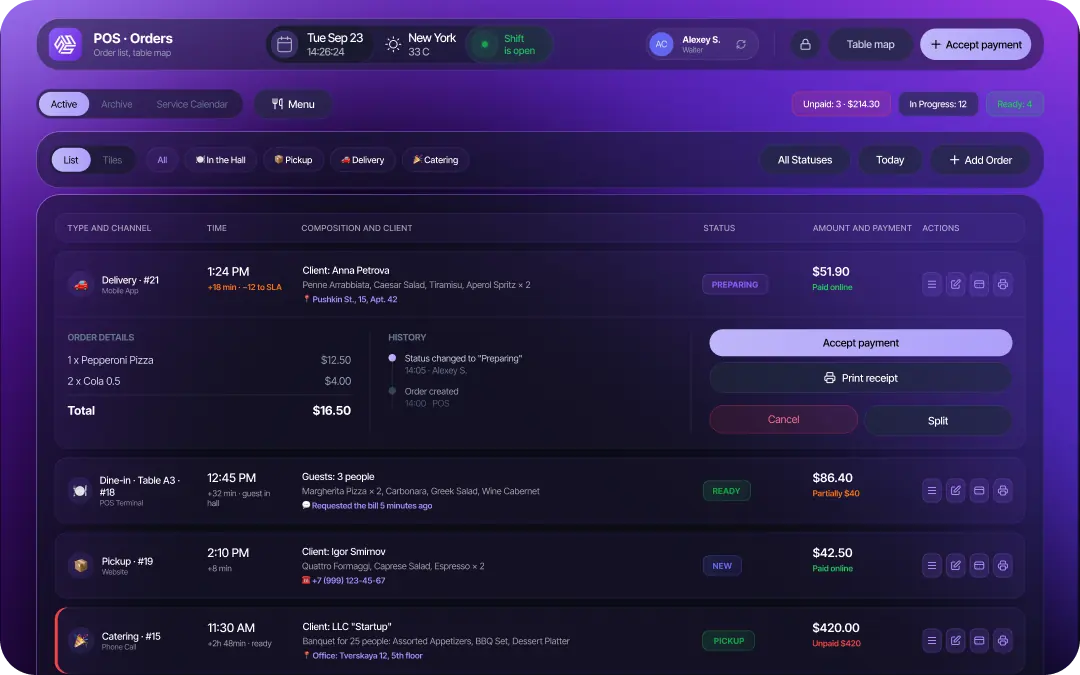
The goal is a single selling workflow: a customer places or requests an order, staff sees it, POS records it, CRM remembers the customer and management can track the result.
This lesson should be completed before a team starts accepting real online orders.
Set order statuses first
Statuses define how the team works: new, confirmed, in progress, ready, out for delivery, completed, cancelled or refunded. A status should mean the same thing to everyone.
Do not copy statuses from a messenger habit. Build them around operations.
Connect customer records
A customer record should keep contact details, order history, notes, preferences, complaints and follow-up tasks. That makes repeat sales and support possible.
If online orders do not create or update customer history, the business loses one of the main benefits of a connected platform.
Run a live-style test
Create a sample order, update status, take payment, edit customer details, trigger a notification and close the order. Then check reporting and inventory impact.
Only launch after the full loop works.
Implementation checklist
- Statuses defined
- Customer fields checked
- Payment flow tested
- Notifications checked
- Reports show the test order
Common mistakes to avoid
- Publishing a page before it answers a real buyer or operator question.
- Using broad claims without showing the workflow, data or module that supports the claim.
- Letting metadata, schema and visible page text describe different things.
- Creating isolated content that does not link to related SABSUS modules, lessons or comparison pages.
- Measuring the page only by visits instead of the action it should create: demo request, call, order, booking, setup step or internal handoff.
Content assets to add next
The page becomes stronger when it is supported by real product and operational proof. Add screenshots, process examples, checklists, before-and-after states, or short clips when they help the reader understand what happens in the business.
For Lesson content, the most useful asset is usually not decoration. It is a concrete view of the workflow: an order status screen, a customer profile, an inventory change, a delivery assignment, a booking slot, a white-label app screen or an owner dashboard.
| Asset | Why it helps |
|---|---|
| Screenshot or workflow image | Shows that the concept is attached to a real system, not only a marketing claim. |
| Checklist | Turns the article into a practical operator resource that can be used during setup. |
| Comparison criteria | Helps buyers and AI systems understand when SABSUS is a fit and when another tool may be enough. |
| FAQ | Answers the exact doubts that block a buyer, owner or implementation team from taking the next step. |
Measurement and next actions
After publishing this page, check whether it is discoverable through internal links, present in the sitemap and represented in content-index.json. The page should also be reachable from at least one hub and one relevant product or module page.
Search Console should be used to watch impressions, query variants and click behavior. Analytics should watch whether users continue to the related SABSUS page, demo request, contact section, pricing page, customer app page or module page. If the page attracts impressions but not actions, the next edit should improve the above-the-fold answer and the internal call to action.
The next content pass should compare this page against the top competing results for the target query. Look for missing buyer criteria, screenshots, FAQ questions, examples, schema and internal links. Add only what makes the page more useful and more specific.
How SABSUS connects this to operations
| Layer | What it should prove |
|---|---|
| Customer and order data | The page should connect search, app, POS, CRM and order history instead of treating them as separate systems. |
| Inventory and fulfillment | The promise on the page should match actual availability, status updates, staff tasks and delivery capacity. |
| Owner control | The owner should be able to review results through reports, analytics, tasks, exceptions and repeat customer behavior. |
Related SABSUS pages
FAQ
Who is this page for?
It is for teams launching the first connected selling workflow.
What should be fixed first?
If POS, CRM and online ordering are configured separately, staff will duplicate work and customer history will split across tools.
What is the SABSUS approach?
Connect order intake, customer creation, POS statuses, payments and CRM history before live launch.